What NMR Spectroscopy Tells You and Why Interest Is Growing in 2026
Nuclear magnetic resonance (NMR) spectroscopy is a technique that reveals the structure of a molecule by measuring how certain atomic nuclei, most often hydrogen-1 and carbon-13, respond to radiofrequency energy inside a strong magnetic field. The result is a spectrum: a set of peaks whose positions, sizes, and splitting patterns tell you which atoms are present, how many there are, and how they’re connected. No other single method gives chemists such a direct view of molecular architecture, and it does so without destroying the sample.
That’s why NMR sits at the centre of work from undergraduate organic labs to pharmaceutical quality control and green chemistry research across Canada. It confirms that a reaction produced the intended compound, flags impurities, and helps teams cut waste by catching problems early. Demand reflects this. The global NMR spectroscopy market was valued at USD 1.31 billion in 2023 and is forecast to reach USD 2.08 billion by 2032.
This article explains how the technique works, how to read a spectrum, and where it’s applied, so you can approach NMR articles and data with confidence.
Key Takeaway: NMR reveals molecular structure and purity, and it is widely used across research and industry. Market forecasts, such as the move from USD 1.31 billion in 2023 to USD 2.08 billion by 2032, point to steady global growth. Canadian students can build these skills through coursework, hands-on training and scholarship support.
How NMR Spectroscopy Works in Plain Language
Reading a Spectrum: Chemical Shift, Splitting and Integration
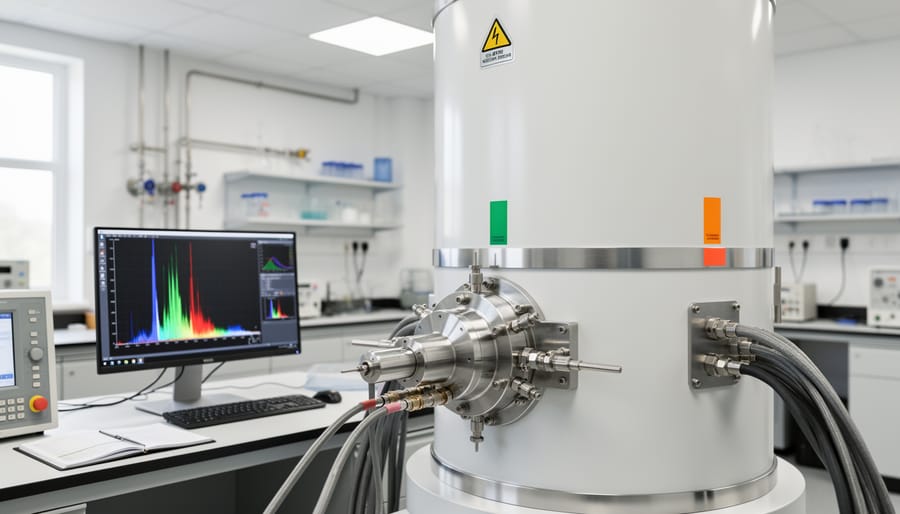
Ethanol (CH3CH2OH) is a friendly first case, because its spectrum shows all three ideas at once. Each one reveals something different about the molecule’s molecular structure.
Chemical shift is the position of a peak along the horizontal axis, measured in parts per million (ppm). It reflects how shielded a nucleus is by nearby electrons. In ethanol’s proton spectrum, the CH3 hydrogens appear furthest upfield, the CH2 hydrogens sit further downfield because the neighbouring oxygen pulls electron density away, and the OH proton appears as its own signal whose position shifts with concentration and solvent.
Splitting tells you about neighbours. A signal splits according to the number of hydrogens on adjacent carbons, following the “n plus 1” rule. The CH3 group sits next to two CH2 hydrogens, so it appears as a triplet. The CH2 group sits next to three CH3 hydrogens, so it appears as a quartet. Spotting a triplet-quartet pair is a classic sign of an ethyl group.
Integration is the area under each peak, which is proportional to the number of hydrogens producing it. Ethanol’s three signals integrate in a 3:2:1 ratio, matching CH3, CH2 and OH. Read together, position, splitting and area let you piece the structure together like a puzzle, one clue at a time.
Where NMR Spectroscopy Is Used: From Teaching Labs to Industry
NMR spectroscopy earns its place in nearly every corner of chemistry because it answers a deceptively simple question: what exactly is in this sample, and is it what we think it is? In teaching labs, that means students confirming the structure of a compound they just synthesized. In industry, it means making sure a batch meets specification before it ships.
Organic chemists lean on NMR most heavily for structure elucidation. By combining proton and carbon-13 spectra, a chemist can piece together how atoms connect, often without needing any other technique. The same data supports purity checks, since stray peaks quickly reveal leftover solvent or an unwanted by-product.
| Field or sector | Typical NMR question answered | Why it matters |
|---|---|---|
| Pharmaceuticals | Is the compound the correct structure, and how pure is it? | Supports quality control and consistent product standards |
| Dyes and pigments | Does the molecular structure match the intended colorant, and are impurities present? | Helps keep batches consistent from one supplier to the next |
| Polymers and materials | What is the composition, chain structure or degree of branching? | Links molecular makeup to physical performance |
| Metabolomics and biomolecules | Which small molecules are present in a biological sample, and how do they change? | Gives researchers a broad, reproducible chemical snapshot |
The common thread is trust in data. When a manufacturer, a contract lab and a customer all work from the same product, a clear, interpretable spectrum gives everyone a shared reference point. That matters in a chemical industry built on rigorous quality standards, where a disagreement over purity or identity can stall an entire shipment.
The technique is also largely non-destructive, so a precious sample can be measured and then recovered for further work. For students and early-career researchers, that makes NMR a practical, low-waste skill to build, and one that carries from the teaching lab straight into industrial practice.
The Canadian Context: Research Strengths and Sustainable Practice
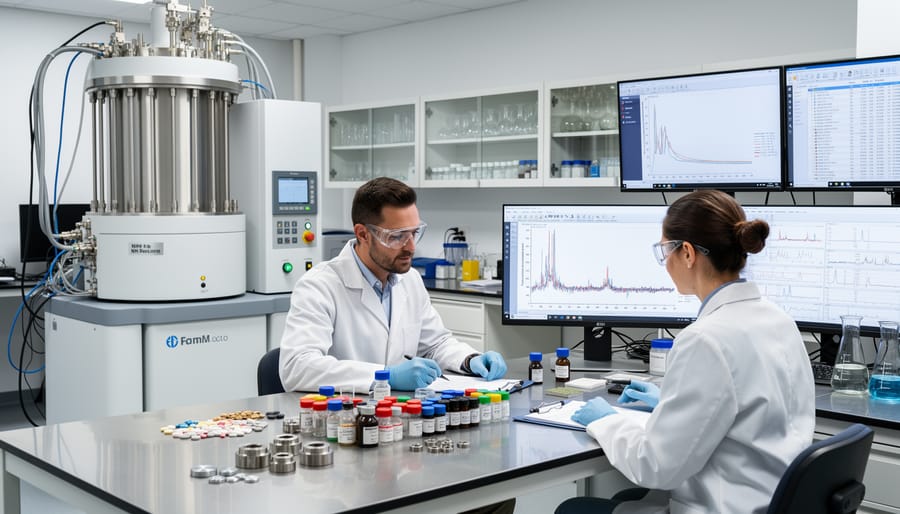
Canada has a long tradition in chemical and physical research, and NMR spectroscopy sits comfortably inside it. University laboratories and national research facilities across the country rely on NMR to confirm structures, check purity and follow reactions, and many undergraduates meet the technique for the first time in a teaching lab. If you want a broader sense of how this heritage connects past and future, the story of chemistry in Canada is a good place to start.
NMR also fits well with responsible practice. It is largely non-destructive, so a sample can often be recovered and used again after analysis. It needs only small amounts of material, which means less reagent consumed and less waste generated at the bench. Confirming purity or a reaction outcome early can stop a chemist from carrying a flawed intermediate through several more steps, saving solvents, energy and time. These habits are a practical part of sustainability in science, not just an abstract ideal.
There are honest trade-offs, though. Many high-field magnets depend on cryogens such as liquid helium, and helium supply is a recognised industry-wide concern, one that affects laboratories well beyond Canada. Facilities weigh these costs when they choose equipment, plan maintenance and decide how to share instrument time. Understanding both the benefits and the limits helps students and researchers use NMR thoughtfully.
Market Growth: What the Numbers Suggest About Demand
Demand for NMR instrumentation is worth watching, though it helps to read the numbers carefully. One market analysis estimates the global NMR spectroscopy market was valued at $1.31 billion (USD) in 2023 and forecasts it to reach USD 2.08 billion by 2032, a compound annual growth rate of about 5 percent.
Two caveats matter here. First, this is a market forecast, not a guarantee, and projections like this depend on assumptions that can shift. Second, it is a worldwide figure. It does not tell us how much of that spending happens in Canada, and we shouldn’t read it as a measure of Canadian activity.
Still, steady growth is plausible for reasons that are easy to understand. Pharmaceutical quality control relies on analytical methods that confirm a compound’s identity and purity, and NMR is well suited to that job. Materials research, including polymers and other advanced substances, calls for detailed structural information. Teaching and research laboratories also need reliable instruments to train the next generation of chemists, and those instruments eventually need replacing or upgrading.
A growth rate around 5 percent is modest rather than explosive, which fits a mature, well-established technique. For students and early-career researchers, the takeaway is simple: NMR is not a passing trend, and building skill in reading spectra is a sound investment for a career in chemistry or a related science.
Getting Started With NMR Spectroscopy as a Student or Early-Career Researcher
The good news for newcomers is that you don’t need instrument access on day one. Start with the fundamentals: a solid grounding in organic chemistry (functional groups, bonding, stereochemistry) makes spectra far easier to interpret, and a short course or textbook chapter on spectroscopy basics will fill in the rest.
Next, practise reading spectra. Work through the problems in your organic chemistry textbook, then try open spectral databases, where you can match real peaks to known compounds. Cover the structure, predict what you’d expect to see, and only then check your answer. A few short sessions each week build intuition faster than occasional long ones.
Hands-on training matters just as much. Ask your supervisor, teaching assistant or facility manager about supervised instrument sessions, and watch an experienced user run a sample before you try. Most university labs have booking and training procedures, so find out what yours requires.
Sample preparation deserves real attention, because a poor sample can ruin an otherwise good experiment. Keep these points in mind:
– Dissolve your compound in a deuterated solvent, which avoids a huge solvent signal swamping your peaks.
– Choose a sensible concentration: too dilute gives weak signals, too concentrated can broaden peaks.
– Use clean, undamaged NMR tubes, and make sure the solution is free of solid particles.
Cost can feel like a barrier, but support exists. Students in chemistry and related fields can look into science scholarships and other financial aid, and our scholarship resources are a good place to begin exploring what’s available. Be patient with yourself. Everyone reading their first spectrum felt a little lost.
NMR Spectroscopy: Common Questions Answered
Short answers to the questions people ask most often are below, so you can check a concept quickly before moving on.
What does NMR stand for?
NMR stands for nuclear magnetic resonance. It refers to the way certain atomic nuclei absorb and re-emit radiofrequency energy when placed in a strong magnetic field.
How is NMR different from infrared spectroscopy or mass spectrometry?
Infrared spectroscopy mainly identifies functional groups through bond vibrations, and mass spectrometry measures the mass of molecules and their fragments. NMR maps how atoms are connected and arranged, which is why chemists often use all three together.
Why are deuterated solvents used?
Ordinary solvents contain hydrogen, and their signals would swamp the sample’s peaks in 1H NMR. Deuterium resonates at a very different frequency, so deuterated solvents keep the spectrum clean, and the instrument also uses the deuterium signal to stay locked on the magnetic field.
Is NMR destructive to the sample?
No. The radiofrequency energy is low enough that the molecules are not altered, so you can usually recover your sample afterward, which suits precious or hard-to-make compounds.
What is the difference between 1H and 13C NMR?
1H NMR detects hydrogen nuclei and is fast and sensitive. 13C NMR detects carbon, giving a view of the molecular backbone, but because carbon-13 is far less abundant, it generally needs more sample or longer acquisition time.
If you are new to the technique, it helps to treat these answers as a starting framework rather than a full course. Once the basics feel familiar, practise reading real spectra and pairing NMR data with other methods, since combining evidence from several techniques is how structures are confirmed with confidence. That habit also reflects good practice in a sustainability-minded lab, where getting the answer right the first time saves solvent, sample and time.
NMR spectroscopy earns its place in the lab because it answers the questions chemists ask most often: what is this molecule, how pure is it, and what is actually in the sample? Chemical shift, splitting and integration turn a few clean peaks into a structural story, and that same data supports quality checks in pharmaceuticals, materials and beyond. Because the method is largely non-destructive and needs only small amounts of sample, it fits comfortably with responsible, low-waste chemical practice.
The growth forecast is a global projection, not a promise, but it matches what working scientists already see: reliable analytical data is the backbone of trustworthy chemistry. If you’re just starting out, keep practising spectrum interpretation, look for supervised instrument time, and get comfortable with careful sample preparation. Each of those steps makes you more confident and more useful in any lab.
Keep exploring the resources on this site as your skills develop, and take a look at our scholarship and financial aid information. Support is there for students in chemistry and related fields, and the right funding can make that next stage of training far more achievable.