
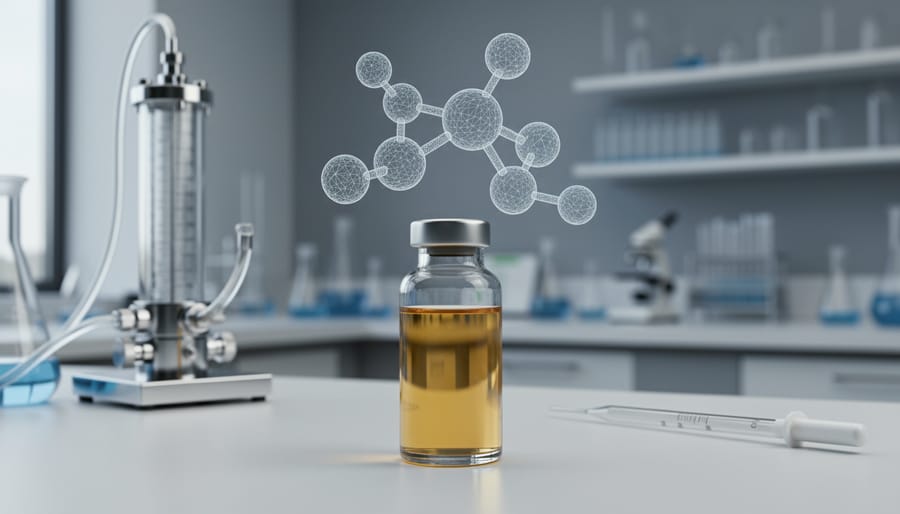
What Is CBD Molecular Weight (and Why Does It Matter)?
Cannabidiol (CBD) has a molecular weight of 314.46 grams per mole, a fundamental value that defines how this cannabinoid behaves in pharmaceutical formulations, laboratory analyses, and chemical synthesis. This precise measurement, derived from CBD’s molecular formula C₂₁H₃₀O₂, represents the sum of all atomic masses in a single molecule and serves as a cornerstone for dosage calculations, solubility predictions, and quality control protocols across the Canadian cannabis and pharmaceutical industries.
Understanding CBD’s molecular weight goes beyond memorizing a number. It provides essential insight into why CBD dissolves preferentially in oils rather than water, how much active compound exists in a given sample, and why certain analytical techniques work better than others for detection and quantification. For students learning pharmaceutical chemistry, researchers developing novel delivery systems, or quality assurance professionals verifying product purity, this value anchors practical calculations that ensure safety, efficacy, and regulatory compliance.
The molecular weight also reveals CBD’s structural complexity. With 21 carbon atoms forming a tricyclic core, 30 hydrogen atoms creating the molecule’s three-dimensional shape, and just 2 oxygen atoms contributing to its pharmacological activity, each component contributes precisely to the final mass. This composition distinguishes CBD from closely related cannabinoids like THC (314.46 g/mol, identical weight but different structure) and CBN (310.43 g/mol, slightly lighter due to fewer hydrogen atoms).
This article breaks down how CBD’s molecular weight is calculated from its chemical structure, examines each molecular component’s contribution, and explores practical applications in chromatography, formulation science, and analytical chemistry. You’ll find clear explanations suitable for academic study, lab work, and industrial applications within Canada’s growing cannabinoid research sector.
Key Takeaway: CBD’s molecular weight of 314.46 g/mol results from 21 carbon atoms (252.21 g/mol), 30 hydrogen atoms (30.24 g/mol), and 2 oxygen atoms (32.00 g/mol). Carbon atoms comprise roughly 80% of the total mass, despite hydrogen being most abundant by number.
What CBD Molecular Weight Means
Molecular weight tells you how heavy a single molecule of a substance is compared to a standard unit. For CBD (cannabidiol), the molecular weight is 314.46 grams per mole, abbreviated as g/mol. This number comes directly from adding up the atomic weights of every atom in CBD’s chemical formula: C₂₁H₃₀O₂.
To understand what this means, think of molecular weight as the sum of all the atoms that make up one CBD molecule. Carbon atoms contribute most of the weight because CBD contains 21 of them, each weighing about 12 atomic mass units. The 30 hydrogen atoms are much lighter (about 1 unit each), while the 2 oxygen atoms add roughly 16 units apiece. When you calculate 21 × 12 + 30 × 1 + 2 × 16, you get 314 atomic mass units, which scientists express as 314.46 g/mol to account for more precise atomic weights.
- Molecular Weight
- The sum of the atomic weights of all atoms in a molecule, expressed in atomic mass units or grams per mole.
- Molar Mass
- The mass of one mole (6.02 × 10²³ molecules) of a substance, numerically identical to molecular weight but expressed in grams per mole.
- Dalton (Da)
- A unit of mass equal to one atomic mass unit, commonly used in biochemistry and pharmaceutical sciences.
- Atomic Mass Unit (amu)
- The standard unit for expressing atomic and molecular weights, defined as one-twelfth the mass of a carbon-12 atom.
- Molecular Formula
- A notation showing the exact number and type of atoms in a molecule, such as C₂₁H₃₀O₂ for CBD.
Scientists often use the terms molecular weight and molecular mass interchangeably in everyday lab work, but there’s a subtle distinction. Molecular mass refers strictly to the mass of a single molecule measured in atomic mass units or Daltons, while molecular weight technically describes the ratio of a molecule’s mass to one-twelfth the mass of a carbon-12 atom. In practice, both give you the same numerical value (314.46 for CBD), and the terms appear throughout pharmaceutical literature, quality control documents, and research papers without causing confusion.
Understanding this foundational number matters because it’s the starting point for virtually every quantitative calculation involving CBD in chemistry and pharmaceutical work. Whether you’re measuring concentration in an extract, calculating how much CBD is present in a sample, or designing a formulation, you’ll use 314.46 g/mol as your reference point.
How Molecular Weight Relates to CBD Structure
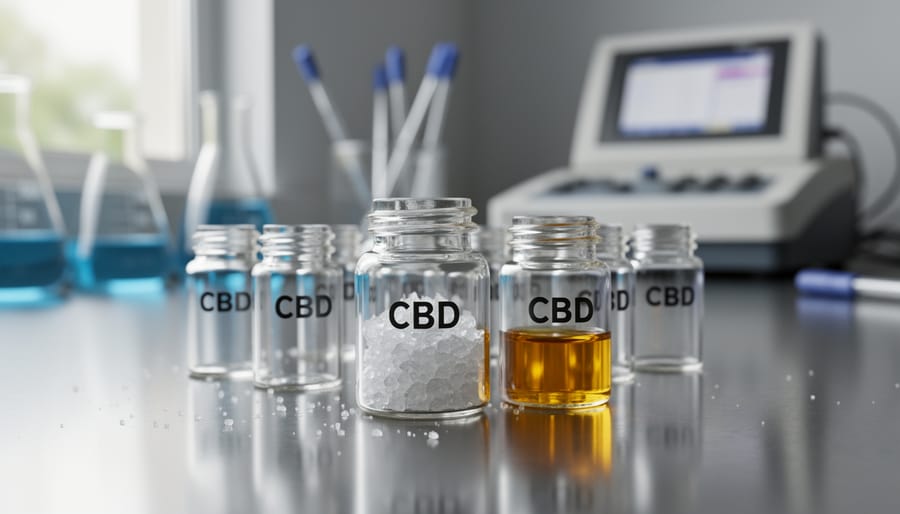
CBD’s molecular weight of 314.46 g/mol isn’t an arbitrary number, it comes directly from adding up the atomic masses of every atom in the CBD structure. The molecule contains 21 carbon atoms, 30 hydrogen atoms, and 2 oxygen atoms, represented by the chemical formula C₂₁H₃₀O₂. Each element contributes a specific amount to the total mass based on standard atomic weights: carbon at approximately 12.01 atomic mass units (amu) per atom, hydrogen at 1.008 amu, and oxygen at 16.00 amu.
When you calculate the contribution of each element, the pattern becomes clear. The 21 carbon atoms account for roughly 252.21 g/mol (21 × 12.01), representing about 80% of CBD’s total molecular weight. The 30 hydrogen atoms add approximately 30.24 g/mol (30 × 1.008), despite being the most numerous atoms in the molecule. The two oxygen atoms contribute 32.00 g/mol (2 × 16.00). Sum these three values, and you arrive at 314.46 g/mol, the precise molecular weight chemists use for calculations.
The three-dimensional arrangement of these atoms matters beyond simple addition. CBD’s structure includes a pentyl side chain, a resorcinol ring system, and a cyclohexene ring, all containing carbon, hydrogen, and oxygen in specific configurations. While the spatial arrangement doesn’t change the molecular weight itself, it determines how tightly the molecule packs, how it interacts with solvents, and how analytical instruments detect it.
This structural-weight relationship explains why molecular weight serves as such a reliable identifier in laboratory settings. When researchers at Canadian pharmaceutical labs use mass spectrometry to confirm CBD identity, they’re detecting the mass-to-charge ratio that corresponds to this exact atomic composition. A single missing or extra hydrogen atom would shift the molecular weight to 313.45 or 315.47 g/mol, immediately flagging a different compound. The precision of molecular weight calculations makes them indispensable for quality control in cannabinoid manufacturing and research.
Understanding this atomic breakdown also clarifies why CBD behaves the way it does in chemical reactions and formulations. The high carbon content contributes to CBD’s lipophilic character, while the oxygen atoms provide sites for potential chemical modifications that researchers explore when developing new cannabinoid-based compounds.
Components That Determine CBD Molecular Weight
CBD’s molecular weight of 314.46 g/mol results from three distinct structural regions, each contributing specific atoms and mass to the overall molecule. Understanding these components illuminates the CBD chemical architecture and explains how small structural variations create different cannabinoids with unique properties.
The pentyl side chain, a five-carbon alkyl group (C₅H₁₁), extends from the resorcinol core and accounts for approximately 71.14 g/mol of CBD’s total weight. This unbranched chain, consisting of five carbon atoms and eleven hydrogen atoms, plays a crucial role in CBD’s lipophilicity and membrane permeability. The length of this chain distinguishes cannabinoids from one another, THC and CBD both feature pentyl chains, while some synthetic or naturally occurring variants have shorter propyl chains, significantly altering their molecular weights and biological activity.
The resorcinol core forms CBD’s aromatic foundation, a benzene ring with two hydroxyl groups (OH) at meta positions. This aromatic system contributes six carbon atoms, four hydrogen atoms, and two oxygen atoms, adding 110.11 g/mol to the structure. The hydroxyl groups create sites for hydrogen bonding and chemical reactivity, influencing how CBD interacts with biological systems and solvents.
The terpene-derived cyclohexene ring, which includes the monoterpenoid moiety characteristic of cannabinoids, contributes the remaining ten carbon atoms and fifteen hydrogen atoms (approximately 135 g/mol). This six-membered ring with one double bond connects to the resorcinol core and contains the isoprenyl group that defines cannabinoid chemistry.
- Pentyl side chain (C₅H₁₁): 71.14 g/mol, determines lipid solubility characteristics
- Resorcinol core (C₆H₄O₂): 110.11 g/mol, provides aromatic stability and reactive hydroxyl sites
- Cyclohexene ring system (C₁₀H₁₅): approximately 135 g/mol, contributes terpene-like properties and structural rigidity
These components combine through covalent bonds to form CBD’s complete C₂₁H₃₀O₂ structure. The specific arrangement and connectivity of these regions differentiate CBD from THC, which shares the same molecular formula and weight but arranges its cyclohexene ring differently, creating a distinct three-dimensional shape with vastly different pharmacological effects.
Why CBD Molecular Weight Matters in Practice

Pharmaceutical and Manufacturing Applications
In pharmaceutical formulation, CBD’s molecular weight of 314.46 g/mol serves as the foundation for accurate dosing calculations. When a manufacturer needs to produce a 10 mg CBD capsule, they calculate the precise mass of pure cannabidiol required, accounting for any carrier oils or excipients. This matters because cannabinoid potency labels must reflect actual CBD content, not the total weight of an oil blend.
Formulation chemists rely on molecular weight to determine solubility characteristics and predict how CBD will behave in different delivery systems. Because CBD has a relatively low molecular weight with specific hydrogen bonding sites, formulators can calculate its partition coefficient between oil and water phases. This guides decisions about whether to use nanoemulsion technology, liposomal encapsulation, or simple oil-based tinctures for optimal bioavailability.
During extraction and purification, molecular weight becomes critical for chromatographic separation. Canadian processors use this value to calibrate high-performance liquid chromatography (HPLC) equipment, ensuring they can distinguish CBD from THC and other cannabinoids despite identical molecular weights. The weight also determines appropriate solvent ratios during crystallization, helping manufacturers achieve pharmaceutical-grade purity levels above 99%.
Quality control laboratories reference molecular weight when conducting mass spectrometry analysis, confirming that extracted material matches CBD’s exact mass-to-charge ratio. This verification step protects against contamination and ensures compliance with Health Canada regulations for cannabis-derived pharmaceuticals.
Analytical and Research Applications
In analytical laboratories, CBD’s molecular weight serves as a critical identifier in mass spectrometry, where researchers use the 314.46 Da signature to distinguish cannabidiol from structurally similar compounds in complex cannabis extracts. High-performance liquid chromatography (HPLC) coupled with mass spectrometry relies on this precise mass value to quantify CBD concentrations in pharmaceutical preparations, ensuring products meet Health Canada’s purity standards for medical cannabis. Researchers studying CBD’s therapeutic power depend on accurate molecular weight data to calibrate analytical instruments and validate extraction protocols.
Canadian laboratories are advancing sustainability in cannabinoid analysis through green chemistry approaches that reduce solvent waste during molecular weight determination. The National Research Council’s cannabinoid research program has developed supercritical CO₂ extraction methods that maintain molecular integrity while minimizing environmental impact, allowing chemists to obtain precise mass measurements without traditional petroleum-based solvents. Universities across Canada now train chemistry students in these eco-conscious analytical techniques, combining fundamental molecular weight calculations with modern sustainability principles. Nuclear magnetic resonance (NMR) spectroscopy, which correlates molecular weight with structural features, has become more energy-efficient through recent innovations in magnet technology, reducing the carbon footprint of cannabinoid research while maintaining the accuracy needed for quality control in Canada’s growing pharmaceutical sector.
CBD Molecular Weight Compared to Related Cannabinoids
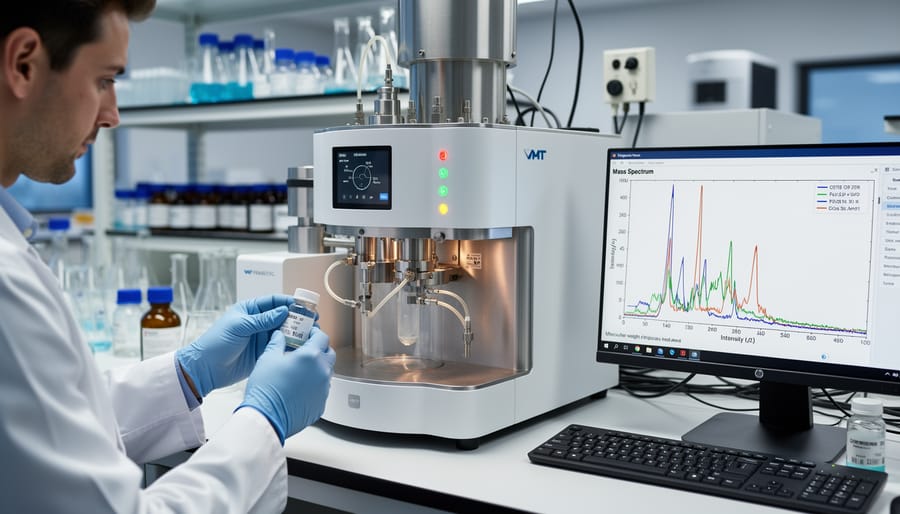
CBD’s molecular weight of 314.46 g/mol places it in a fascinating category among cannabinoids, it shares this exact mass with Δ⁹-THC, yet the two compounds behave completely differently in the body. This identical molecular weight exists because CBD and THC are structural isomers: they contain precisely the same atoms (C₂₁H₃₀O₂) but arrange them differently in three-dimensional space. THC features a closed ring structure where CBD has an open hydroxyl group, changing how these molecules interact with receptors despite their matching mass.
Other major cannabinoids cluster closely around this weight but differ enough to be distinguishable by sensitive instruments. CBN (cannabinol) weighs 310.43 g/mol because it contains one fewer hydrogen atom and one additional double bond compared to CBD, reflecting its formation through THC oxidation. CBG (cannabigerol), at 316.48 g/mol, has a slightly higher mass due to differences in its resorcinol core structure. CBC (cannabichromene) matches CBD and THC at 314.46 g/mol, another structural isomer with a distinct bicyclic ring system.
These small mass differences and structural variations create significant challenges for analytical separation. When CBD and THC share identical molecular weights, mass spectrometry alone cannot definitively identify which compound is present in a sample. Canadian laboratories use high-performance liquid chromatography (HPLC) or gas chromatography (GC) to exploit the different polarities and boiling points these isomers exhibit, physically separating compounds before detection. Two-dimensional NMR spectroscopy provides another powerful tool, revealing structural details that mass alone cannot capture.
Understanding these relationships helps researchers anticipate separation difficulties and choose appropriate analytical methods. In manufacturing settings where purity standards matter, particularly for pharmaceutical-grade CBD production, knowing that structural isomers exist at identical molecular weights reinforces why multi-technique verification remains essential. A single mass spectrometry reading showing 314.46 g/mol could indicate CBD, THC, or CBC; only structural analysis confirms which cannabinoid you’ve isolated.
How Cbd Molecular Weight Works

Understanding how molecular weight works requires grasping the straightforward calculation behind it. Scientists determine CBD’s molecular weight by adding together the atomic masses of every atom in its chemical formula, C₂₁H₃₀O₂.
Each element contributes a specific amount to the total. Carbon atoms have an atomic mass of approximately 12.01 amu, hydrogen atoms weigh about 1.008 amu, and oxygen atoms contribute roughly 16.00 amu. For CBD, multiply 21 carbon atoms by 12.01, then add 30 hydrogen atoms multiplied by 1.008, plus 2 oxygen atoms multiplied by 16.00. This calculation yields 314.46 g/mol.
The process works identically for any molecule. What makes CBD’s molecular weight meaningful is how it connects to real measurements. When chemists weigh out CBD samples in the lab, they use this number to convert between mass in grams and the number of molecules present. A sample weighing 314.46 grams contains exactly one mole, approximately 6.022 × 10²³ molecules.
This relationship between molecular weight and measurable quantities enables precise formulation work. Canadian pharmaceutical researchers rely on these calculations daily to design consistent, accurate CBD products that meet rigorous quality standards.
Common Questions About CBD Molecular Weight
How is CBD’s molecular weight measured in the laboratory?
Mass spectrometry is the primary analytical technique for determining molecular weight, where CBD molecules are ionized and their mass-to-charge ratio is measured with high precision. Alternative methods include chromatographic techniques combined with molecular weight-sensitive detectors, though mass spectrometry remains the gold standard for accuracy.
Why do CBD and THC have identical molecular weights if they’re different compounds?
CBD and THC are structural isomers, meaning they share the same molecular formula (C₂₁H₃₀O₂) but have different arrangements of their atoms in three-dimensional space. This structural difference creates distinct pharmacological properties despite identical molecular weights of 314.46 g/mol.
Does molecular weight affect CBD’s bioavailability in pharmaceutical formulations?
Molecular weight influences but doesn’t solely determine bioavailability. Lower molecular weight compounds generally cross biological membranes more easily, and CBD’s moderate molecular weight of 314.46 g/mol contributes to its lipophilic characteristics and absorption profile. However, factors like solubility, formulation method, and delivery route play equally important roles in determining how effectively CBD enters systemic circulation.
What instruments do Canadian research laboratories use to measure cannabinoid molecular weights?
High-resolution mass spectrometers, including time-of-flight (TOF) and quadrupole systems coupled with liquid chromatography (LC-MS), are standard equipment in cannabinoid research facilities. Canadian universities and pharmaceutical companies increasingly employ these instruments for quality control, compound identification, and cannabinoid research projects supported through science scholarships and Canadian science scholarships focused on advancing analytical chemistry capabilities.
Understanding these fundamental questions helps chemistry students and professionals apply molecular weight concepts to real-world cannabinoid analysis. When you encounter CBD molecular weight in research papers or laboratory settings, you’re seeing a precise measurement that reflects the sum of atomic masses in the C₂₁H₃₀O₂ structure. This value remains constant regardless of CBD’s source or extraction method, making it a reliable identifier in quality control protocols.
The relationship between molecular weight and analytical detection becomes particularly important in pharmaceutical manufacturing, where accurate identification distinguishes CBD from structurally similar cannabinoids. Mass spectrometry data showing a molecular ion peak at 314.46 confirms CBD presence, but additional structural analysis through fragmentation patterns is required to differentiate it from THC or other isomers with identical weights. This combination of molecular weight determination and structural characterization forms the foundation of cannabinoid quality assurance in Canadian laboratories.
Understanding CBD’s molecular weight of 314.46 g/mol is far more than memorizing a number. It represents the foundation for precise pharmaceutical formulations, quality control protocols, and analytical chemistry techniques that shape the Canadian cannabinoid industry. This fundamental property connects molecular structure to practical applications, from calculating accurate dosages to identifying compounds through mass spectrometry.
For students and researchers in Canada, mastering molecular weight calculations opens doors to careers in pharmaceutical development, analytical chemistry, and chemical manufacturing. The skills you develop through studying cannabinoid chemistry, from structural analysis to quantitative measurements, translate directly to laboratory work and product development roles. Canadian research institutions continue advancing cannabinoid science, particularly in sustainable extraction methods and analytical standards that set international benchmarks.
The pharmaceutical industry relies on scientists who understand these foundational concepts. Whether you’re pursuing chemistry, biochemistry, or pharmaceutical sciences, the principles behind molecular weight calculations remain essential across all applications. Quality assurance teams verify compound identity, formulation chemists design delivery systems, and research scientists explore therapeutic applications, all building on this same structural knowledge.
Canadian students interested in advancing cannabinoid research or pharmaceutical chemistry can explore scholarship opportunities through organizations like the Natural Sciences and Engineering Research Council of Canada (NSERC) and provincial research foundations. These programs support the next generation of scientists who will shape cannabis science, sustainable chemistry practices, and pharmaceutical innovation across the country.